Research

Projects

From interpersonal synchrony in humans to visual simulation in great apes: what I have worked on, with whom, and what came out of it.

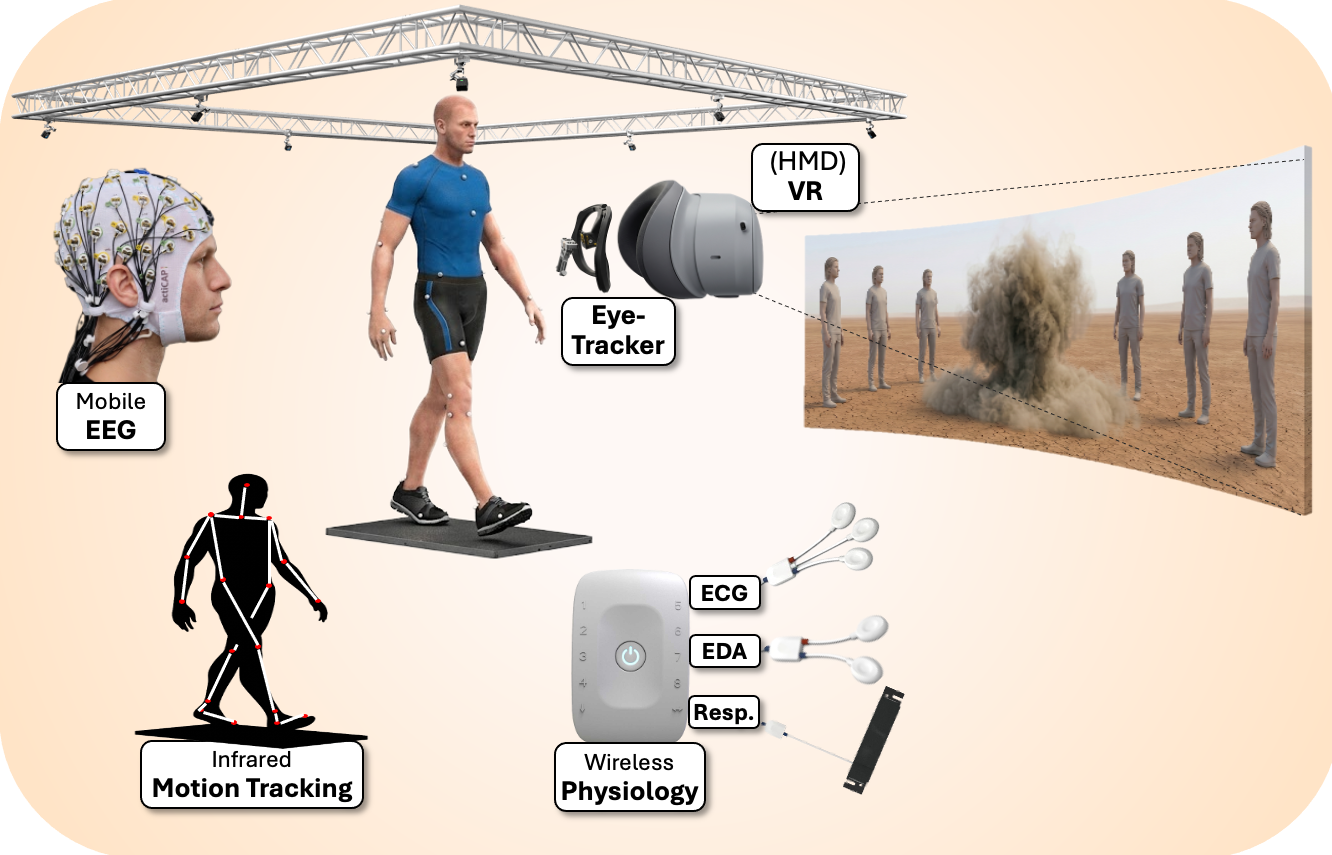
Planned PhD setup: mobile EEG, infrared motion tracking, eye tracker, wireless physiology (ECG, EDA, respiration) and a head-mounted VR scene with virtual people

PhD · ongoing IMPRS LIFE · 2026 – present

The Multi-Level Influences of Social Information:
a Multimodal, Virtual Reality Approach

In my PhD I investigate how social information influences us at the level of perception, decision and affect. Most lab studies of social influence have used static or non-interactive tasks, lacking the complexity of real-life social situations, with multiple agents. Here, I combine immersive virtual reality, which recreates naturalistic scenes with multiple people under tight experimental control, with mobile multimodal recordings (EEG, eye tracking, motion tracking and physiology) to capture brain–body dynamics as situations unfold. At the core is a novel ambiguous approach–avoidance task, where a disambiguating predator/prey stimulus forces high-stakes approach-avoidance decisions. Across different experiments, I populate this 3D world with virtual social agents, manipulating their social information in gaze, behavior and emotions.

Supervisors
Prof. Marcel Brass · Dr. Michael Gaebler
Labs
Social Intelligence Lab · Mind Body Emotion Lab
Institutions
IMPRS LIFE · Max Planck Institute for Human Development · Humboldt University of Berlin
Methods
EEGECG / EDA / respirationMotion captureEye trackingVirtual reality
Open science EnvisionBOX · 2025 – present

EnvisionBOX: building open exchange for multimodal research

I am a core member of EnvisionBOX, an open, community-driven platform that promotes a culture of sharing knowledge and labour among researchers who work with multimodal data to understand embodied minds in interaction and communication. It offers coding modules to process, analyse and classify multimodal data streams, curated lists of open-access datasets and diamond open-access journals, and events such as summer and winter schools and workshops.

Core team
Wim Pouw · Babajide Owoyele · James Trujillo · Davide Ahmar · Šárka Kadavá · Anna Palmann
Institution
EnvisionBOX
Resources
Website · Coding modules · About us · Open datasets · Diamond open-access journals · Events

Comparative cognition MPI EVA Leipzig · 2025 – 2026

Visual simulation in great apes (PLANKO)

Can great apes mentally simulate how objects will move? In this project we test whether chimpanzees, bonobos, gorillas and orangutans can predict where a ball will land as it falls through an array of planks (the PLANKO task), a paradigm recently used to show visual simulation in macaques (Ahuja et al., 2024). Using accuracy and reaction time, and controlling for simple heuristics such as the number of planks, their orientation or the first plank hit, we ask whether their choices are better explained by simulation or by low-level visual shortcuts.

Supervisors
Dr. Christoph Völter · Dr. Matthias Allritz
Lab
Comparative Cultural Psychology
Institution
Max Planck Institute for Evolutionary Anthropology, Leipzig
Methods
Touchscreen tasksEye trackingGreat apes

Open-source methods Donders Centre for Cognition · 2024 – 2025

Mobile Multimodal Lab

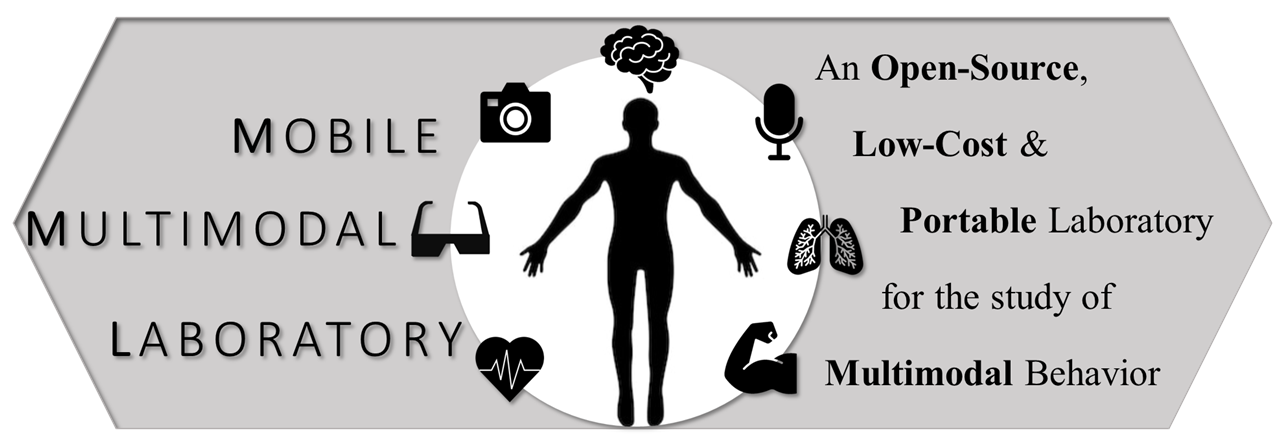
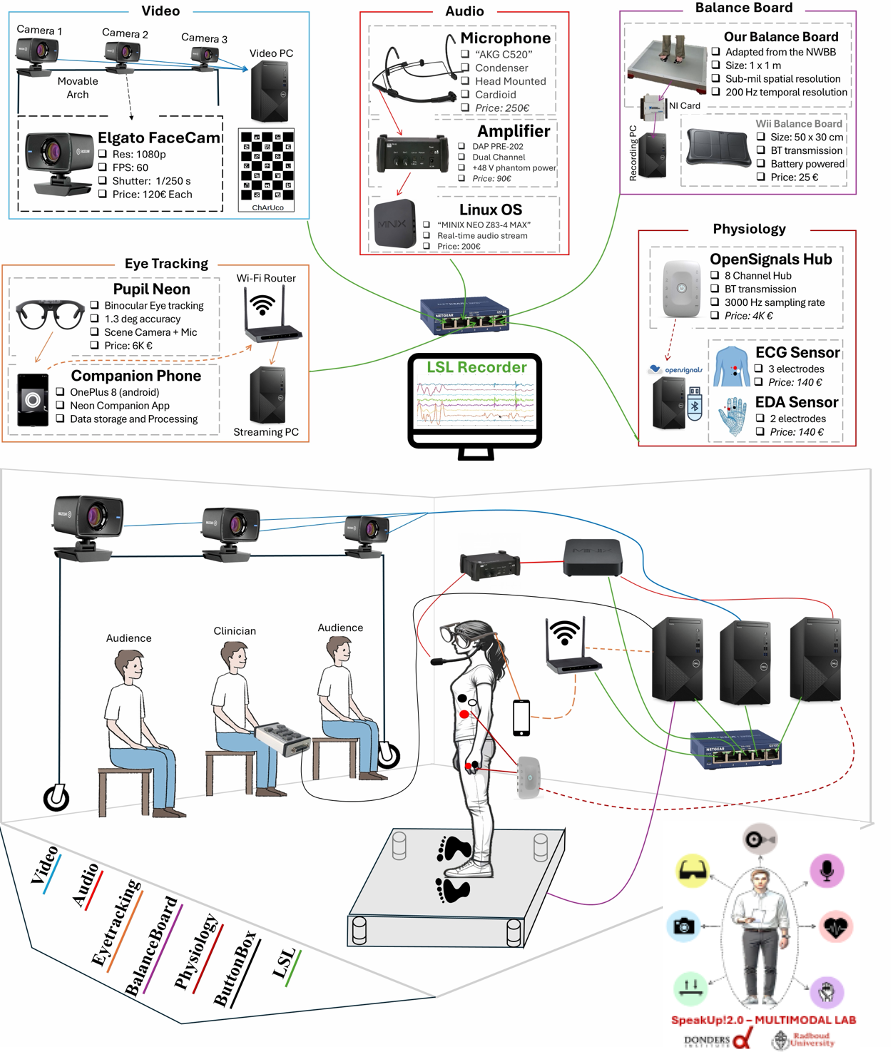
Multimodal research is hard to set up: auditory, visual and physiological signals each have their own characteristics and must be carefully integrated and synchronised. The Mobile Multimodal Lab (MML) is an open-source, low-cost (less than 10K) and easily transportable laboratory that lets researchers capture multimodal behaviour of individuals or interacting people in a wide range of settings. It combines frame-synced 2D videos (for 3D motion tracking), audio and physiological signals (ECG, EMG, respiration), can be extended with systems such as EEG or eye tracking, and uses Lab Streaming Layer to synchronise all streams with sub-millisecond precision. A step-by-step manual and a coding library, demonstrated with a proof-of-concept interpersonal singing experiment, take researchers from setup to analysis.

Collaborators
Dr. Wim Pouw, Šárka Kadavá
Institution
Donders Institute, Radboud University
Methods
Lab Streaming LayerMotion trackingAudio recording Electromyography (EMG) Electrocardiography (ECG) Respiration Open Hardware & Software
Code & manual
GitHub repository
Work in progress...

Outputs

  • Ahmar, Kadavá & Pouw. Mobile Multimodal Lab: An open-source, low-cost and portable laboratory for the study of human behavior. In preparation.
SpeakUp! 2.0 Multimodal Lab: setup with three cameras, head-mounted microphone, balance board, eye-tracking glasses and wireless physiology sensors synchronised through Lab Streaming Layer, with the Donders Institute and Radboud University logos

MSc thesis Donders Centre for Cognitive Neuroimaging · 2023 – 2024

Subtle avoidance during exposure therapy for public speaking

An interdisciplinary project testing whether non-invasive brain stimulation (tACS) can make exposure therapy more effective for socially anxious people.

Subtle avoidance had mostly been assessed with self-reports or evaluations before and after exposure, never quantitatively during a live session. For my thesis I introduced a multimodal approach to capture it objectively, built on a modular, cost-effective and portable system that synchronises data streams from many devices. In a proof-of-concept study, participants gave a short public speech while we recorded their movements (multiple cameras), speech (head-mounted microphone), posture (balance board), gaze (eye-tracking glasses), and heart rate and skin conductance (wireless sensors).

Supervisors
Prof. Ivan Toni · Prof. Karin Roelofs · Mariana Carneiro de Andrade
Institution
Donders Centre for Cognitive Neuroimaging, Nijmegen
Methods
tACSKinematicsSpeechEye trackingPhysiologyPosture

Outputs

  • MSc thesis: Multimodal measures of subtle avoidance during exposure therapy for public speaking: a proof-of-concept study.
  • de Andrade, M. C., Ahmar, D., Dijkstra, N., Meijer, S., Bramson, B., Hutschemaekers, M., Kampman, M., Toni, I., & Roelofs, K. (2024). Neurally enhanced control over social avoidance during public speaking exposure in social anxiety. Proceedings of the Annual Meeting of the Cognitive Science Society, 46. DOI
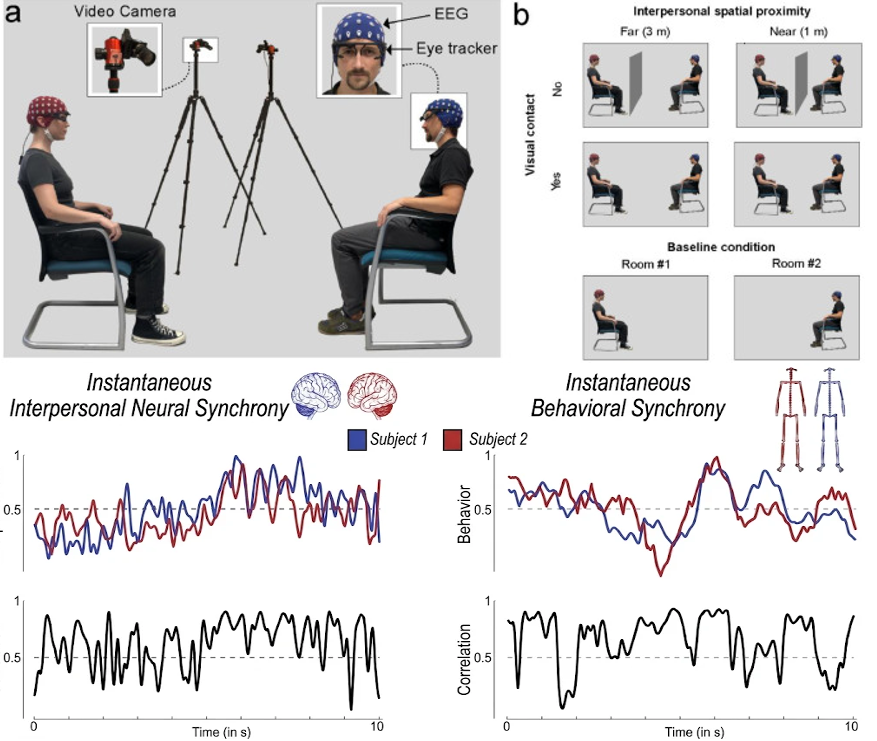
Dual-EEG setup with two seated participants, the experimental conditions, and time series of instantaneous neural and behavioural synchrony

Hyperscanning Italian Institute of Technology, Rome · 2021 – 2022

Spontaneous interpersonal synchrony of bodies and brains

When two people simply look at each other, without speaking or gesturing, do their brains and bodies fall into sync? We recorded EEG, full-body kinematics, eye movements and facial expressions from pairs of participants who were only asked to look at each other. Interpersonal neural synchrony (INS) emerged spontaneously, but only when partners could see each other, and it reflected real-time, dyad-specific coupling of brain activity rather than individual changes in neural activity. Using video processing and deep learning, we extracted three social cues (body movement, eye contact and smiling) and found that they also synchronised within pairs. Cross-correlation and Granger causality analyses showed that synchronised behaviour anticipates, and Granger-causes, neural synchrony. This suggests that INS is an emergent property of two coupled neural systems: an entrainment phenomenon promoted by real-time dyadic behaviour.

Collaborators
Dr. Giacomo Novembre · Dr. Atesh Koul · Prof. Gian Domenico Iannetti
Institution
Italian Institute of Technology — Neuroscience of Perception & Action
Methods
Dual-EEGMotion trackingEye trackingPhysiologyFacial expressionsDeep learningGranger causality

Outputs

  • Koul, Ahmar, Iannetti & Novembre (2023). Spontaneous dyadic behavior predicts the emergence of interpersonal neural synchrony. NeuroImage. DOI
  • Koul, Ahmar, Iannetti & Novembre (2023). Interpersonal synchronization of spontaneously generated body movements. iScience. DOI
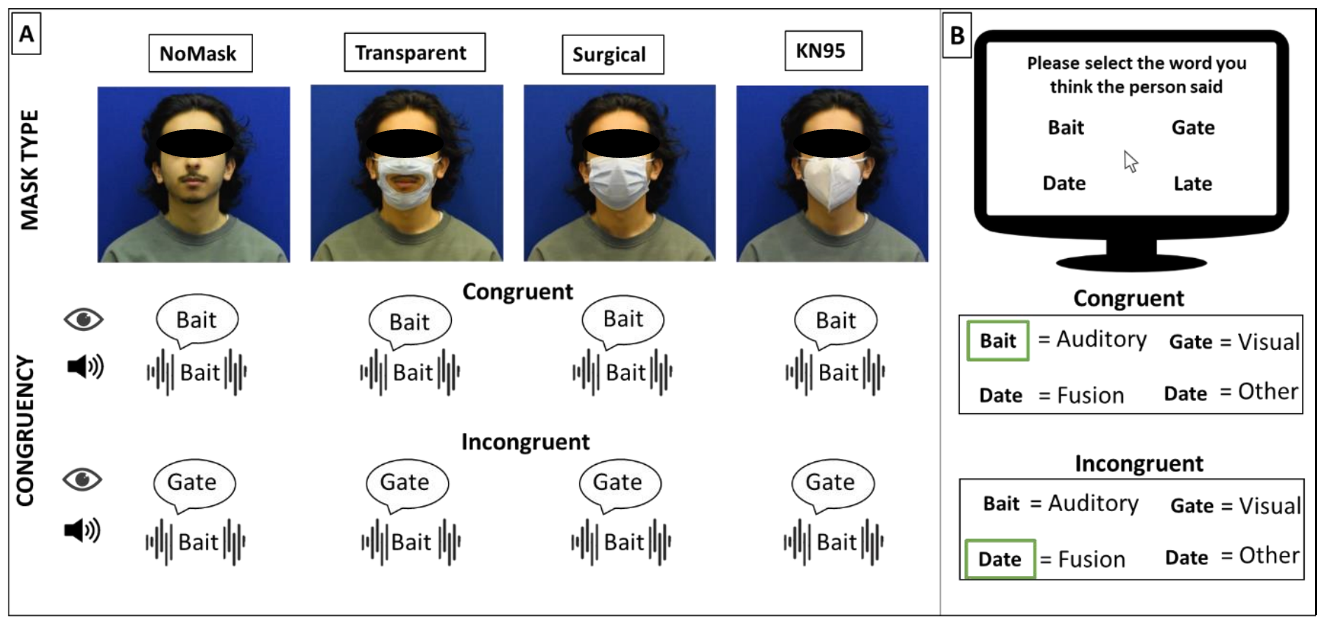
McGurk task design: a speaker with no mask, transparent, surgical and KN95 masks, congruent and incongruent audiovisual words, and the response screen

BSc thesis University of Manchester · 2021 – 2022

Hearing masks and seeing voices

During the COVID-19 pandemic, face masks hid speakers' mouths and degraded the sound of speech. Using the McGurk effect, an illusion in which mismatching lip movements and sounds fuse into a new percept, I tested how transparent, surgical and KN95 masks affect audiovisual integration. Participants were more accurate and faster when they could see the mouth, and only experienced the fusion when it was visible, including through the transparent mask.

Institution
University of Manchester
Methods
Audiovisual speechMcGurk paradigmForced-choice task